White Vinyl

Standard MAX Strength

Engineered for hard-to-stick, low-energy, and lightly textured surfaces where conventional adhesives may struggle. Its aggressive permanent adhesive delivers exceptional holding power for demanding indoor and outdoor applications.
Printed Vinyl Standard MAX Strength

Features

  • 3.5 mil calendered high-tack vinyl
  • Aggressive adhesive for hard-to-stick surfaces
  • Designed for low-energy plastics and light textures
  • Suitable for indoor and outdoor graphics
  • Performs in cooler installation conditions

Typical Uses

  • Industrial labels and equipment graphics
  • Brick, concrete, and stucco
  • ABS, polyethylene, and polypropylene plastics
  • Outdoor signs and identification graphics
  • Automotive and transportation markings

Not Recommended

  • Temporary or easily removable graphics
  • Full vehicle or trailer wraps
  • Deep channels or complex curves
  • Unsealed, dusty, or crumbling masonry
  • Surfaces that may be damaged during removal

Material Overview

Standard MAX Strength White Vinyl is an industrial-grade material designed for surfaces that are traditionally difficult to bond to. Its aggressive permanent adhesive performs well on many low-energy plastics, lightly textured surfaces, and properly prepared masonry where standard High-Tack vinyl may not provide sufficient holding power.

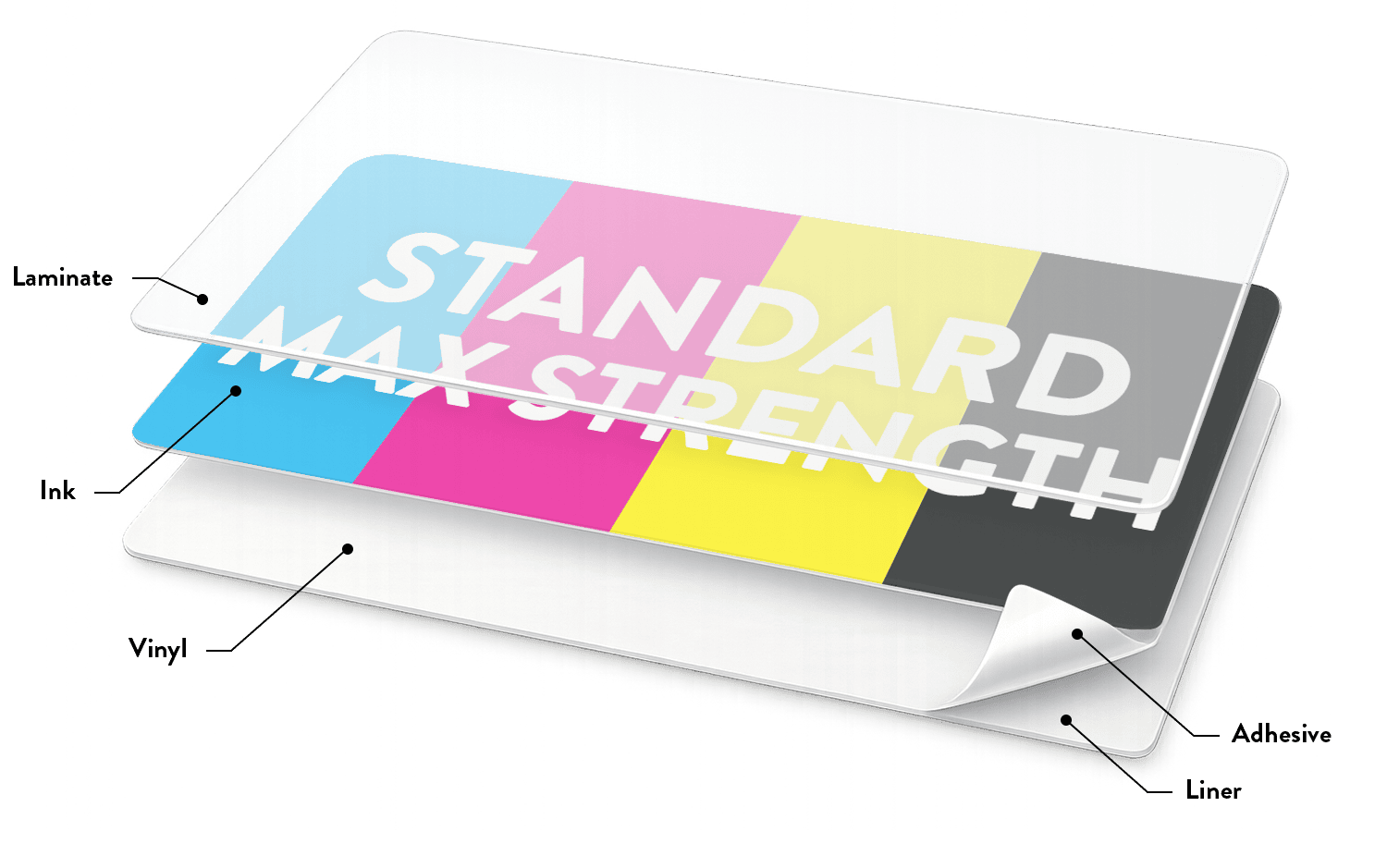
The durable 3.5 mil face film offers dependable handling and can conform to flat surfaces with slight contours. This material is commonly selected for industrial labels, equipment decals, vending applications, utility markings, sealed masonry graphics, and other demanding installations where adhesion is the primary concern.

Durability on exterior masonry and other challenging surfaces may be considerably shorter. Surface condition, sealing, weather exposure, installation technique, and environmental conditions all affect final performance.

Surface Compatability

See how this material performs on common application surfaces. Compatibility ratings help you determine where this material works best and when additional testing or a different material may be recommended.

Learn more about low and high surface energy

Full Specs

Explore the complete technical specifications for this material, including film construction, adhesive properties, durability, application guidelines, and other detailed performance information.

Applications General, Walls, Windows, Electronic Devices
Thickness (before laminate) 3.5 mil
Application Surfaces Flat, Textured, Simple Curves
Adhesive or Cling Strength High Tack Aggressive
Adhesive or Cling Type Pressure Sensitive
Removability May require heat assist or other tools
Air Egress (Air Release) No
Film Type Intermediate Calendered Vinyl
Backside Color White
Blockout Opacity 96%
Estimated Indoor Lifespan Indefinite. UV exposure may promote fading.
Estimated Outdoor Lifespan Up to 5 years
Nerdy details
Film Finish (before laminate) Semi-Gloss
Liner Type Lay-flat polycoated
See-Thru Visibility Not See-Thru
Water Tolerance Water Resistant. Do Not Saturate.
Application Temperature 30°F to 80°F
Service Temperature -65°F to 225°F

Helpful Info

Helpful tips, recommendations, and best practices to get the most from this material before, during, and after installation.
  • This is our strongest adhesive option and should be selected when maximum holding power is more important than easy removal.
  • Hard-to-stick surfaces must still be thoroughly cleaned and tested before production or installation.
  • Porous masonry performs best when sealed to reduce dust, moisture migration, and adhesive failure.
  • A firm final pass with a soft roller helps press the adhesive into lightly textured surfaces.
  • Heat may improve installation and removal, especially in cooler conditions or on uneven surfaces.
  • Exterior masonry applications may have a much shorter service life than installations on smooth, sealed substrates.

FAQ

Answers to questions about this material, compatibility, durability, installation, and applications

MAX Strength uses a more aggressive adhesive engineered for difficult substrates such as low-energy plastics, sealed masonry, and lightly textured surfaces. Standard High-Tack is better suited to conventional smooth surfaces and may be easier to remove.

Yes, but these surfaces should be clean, dry, stable, and preferably sealed. Loose grit, chalk, dust, moisture, or deteriorating coatings can prevent proper adhesion and shorten the installation lifespan. If unsealed, because of the porous nature of all masonry and its general roughness, expect water, snow, or ice to seep between the film and wall and collect on the upper edges of the applied graphic. For this reason, an edge seal is recommended on applications that have very rough surfaces.

It can be removed, but it is not designed as a removable material. Its aggressive permanent adhesive may leave residue or damage delicate coatings, especially after a long installation. Heat can often make removal cleaner and easier.

Yes. This material is specifically designed for many hard-to-stick plastics, including polyethylene, polypropylene, polyurethane, and ABS. Testing is still recommended because plastic formulations and surface treatments vary.

It may be used for flat or slightly contoured decals and markings. It is not intended for full wraps, deep channels, rivets, or complex compound curves.

Have Questions?

Leave a Reply

Your email address will not be published. Required fields are marked *

This site uses Akismet to reduce spam. Learn how your comment data is processed.